Types of mehndi: popular designs for every occasion
Mehndi — also called henna — is one of the most beautiful and expressive forms of body art. It has been part of Indian, Middle Eastern, and South Asian traditions for centuries, applied at weddings, festivals, religious ceremonies, and family celebrations. Over time it has grown from dense traditional patterns into bold Arabic trails, delicate minimal designs, glamorous white and glitter art, and tattoo-inspired motifs. This illustrated guide explains seven popular styles and helps you pick the right one for your celebration.
At a glance: the seven styles
| Style | Signature look |
|---|---|
| Traditional Indian | Dense, intricate, and symbolic |
| Arabic | Bold floral trails with open spaces |
| Minimalist | Simple, delicate, and modern |
| Rajasthani | Royal, detailed, and story-driven |
| Indo-Western | Traditional motifs with contemporary elements |
| White & glitter | Decorative, glamorous, and photo-friendly |
| Tattoo mehndi | Compact, body-art inspired motifs |
The right style depends on the occasion, your outfit, how much time you have for application, and how much detailing you like. Here is each one up close.
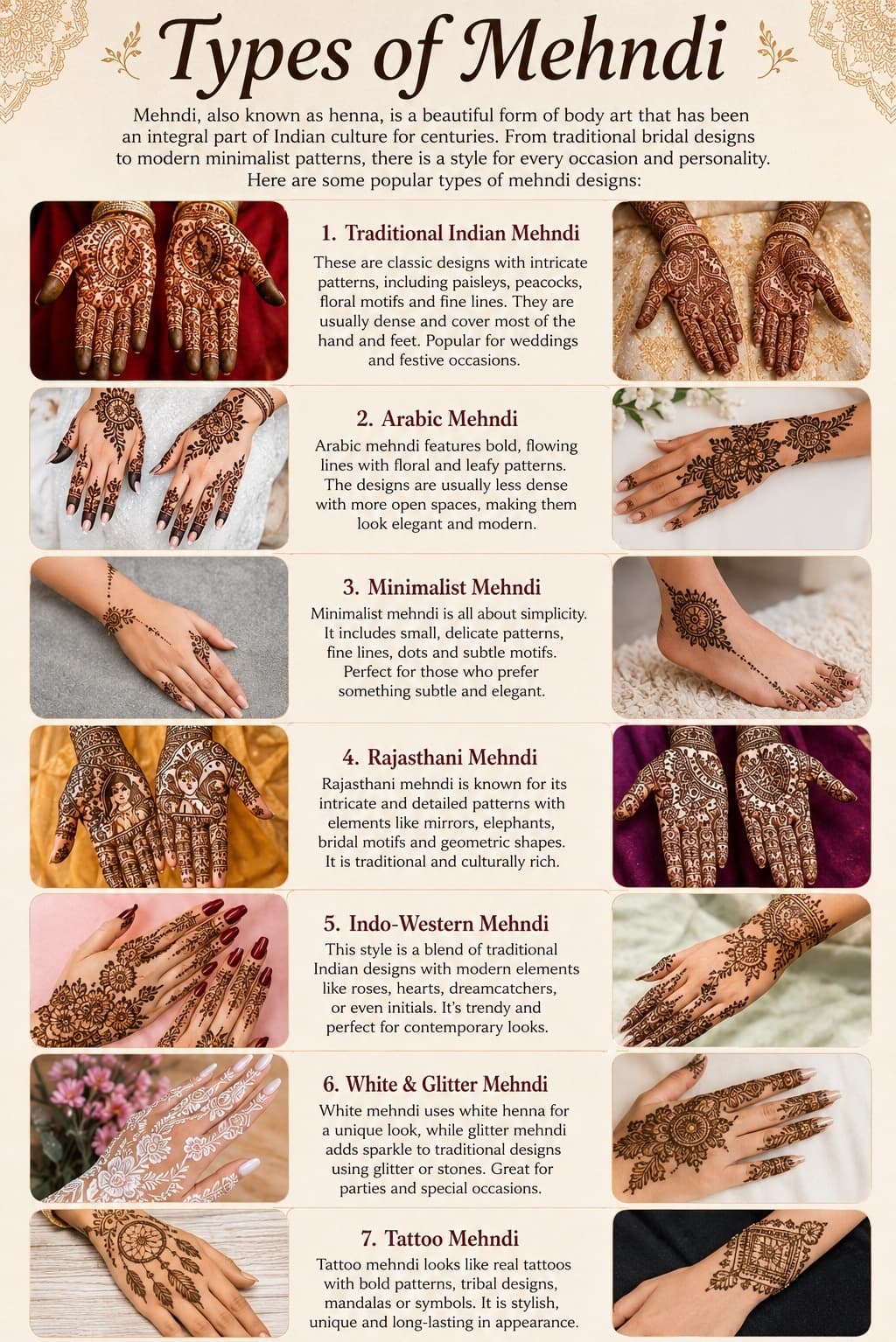
1. Traditional Indian mehndi
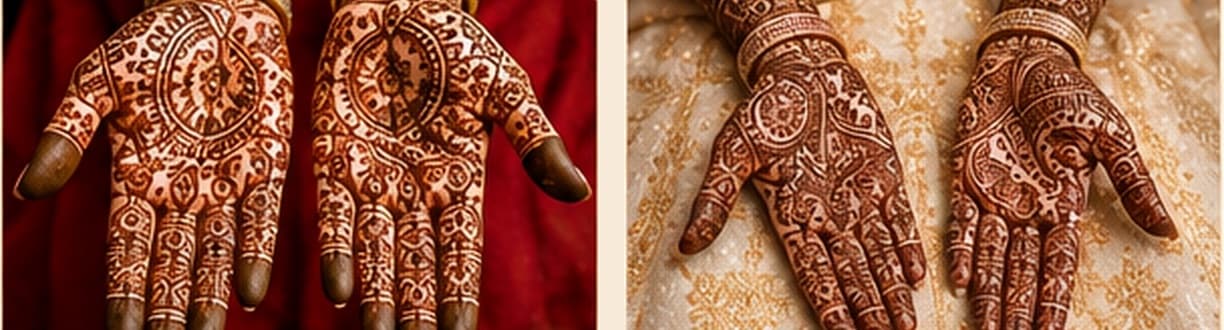
Traditional Indian mehndi is known for its rich, detailed, intricate look. The patterns usually cover most of the palms, fingers, hands, and feet, leaving very little empty skin.
Common elements include paisleys, peacocks, lotus flowers, leaves, mandalas, elephants, religious symbols, and bride-and-groom figures. Bridal designs often hide the groom's name or initials somewhere in the pattern.
This style is deeply tied to Indian weddings and festivals — the choice when mehndi is meant to be a major part of the overall bridal or festive look.
Best for — weddings, bridal ceremonies, Karwa Chauth, Teej, Diwali, and traditional functions.
2. Arabic mehndi

Arabic mehndi is recognised by bold floral patterns, flowing vines, leafy trails, and elegant curves. Instead of filling the whole hand, it uses open skin as part of the design.
A typical pattern starts at one finger and flows diagonally across the palm, or runs from the wrist toward the back of the hand. Thick outlines make it look graceful and striking — and because there are fewer tiny details, it's usually much faster to apply than dense bridal work.
Best for — Eid, parties, family functions, festive events, bridesmaids, and quick applications.
3. Minimalist mehndi

Minimalist mehndi is about simplicity: clean lines and delicate detailing. Instead of covering the whole hand, it might be a small mandala, a leafy vine, finger accents, tiny flowers, or a bracelet-style band.
It feels light and contemporary — a good match for modern outfits and intimate events, for first-timers, and for anyone who prefers understated body art. Minimal designs are quick to apply and pair easily with office wear, western outfits, or simple ethnic clothing.
Best for — small gatherings, office parties, casual functions, beginners, and modern outfits.
4. Rajasthani mehndi

Rajasthani mehndi is known for cultural richness, intricate storytelling, and highly detailed compositions. Designs often feature kings and queens, bride-and-groom portraits, palaces, elephants, horses, mirrors, and geometric borders.
A signature feature is the mirror-effect layout, where both hands carry matching or complementary imagery. The density and symmetry create a royal, ceremonial look. These elaborate designs can take several hours — but their personalised, traditional character makes them especially popular with brides.
Best for — brides, royal-themed weddings, traditional ceremonies, and cultural celebrations.
5. Indo-Western mehndi
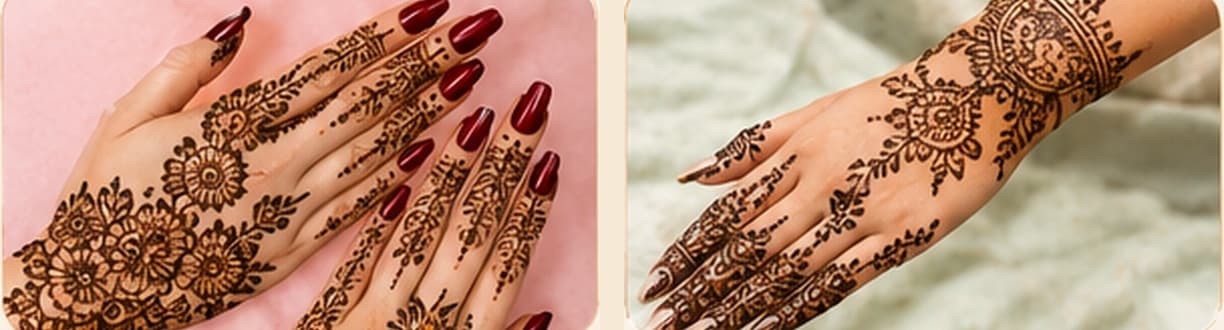
Indo-Western mehndi combines traditional Indian patterns with modern design elements. Flowers, paisleys, and mandalas get paired with hearts, roses, stars, feathers, dreamcatchers, initials, or abstract shapes.
The result is creative and highly personal — some designs look like jewellery, others like temporary tattoos arranged across the fingers, hand, or forearm. Because it suits both ethnic and western clothing, it's a versatile pick for modern weddings and social events.
Best for — engagements, cocktail parties, college events, destination weddings, and fashion shoots.
6. White and glitter mehndi
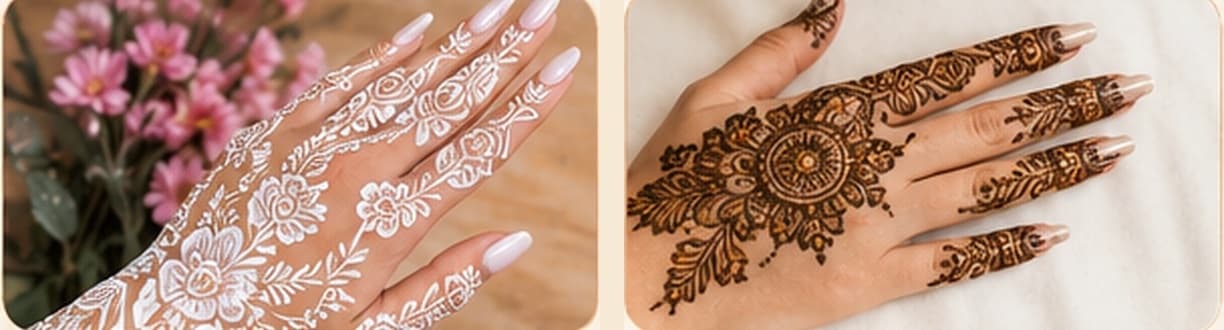
White and glitter mehndi is a decorative alternative to traditional brown henna. White designs create a bright, lace-like effect, while glitter, crystals, or stones add sparkle and colour.
White mehndi is usually made with cosmetic body adhesive or body paint rather than natural henna — it sits on top of the skin instead of leaving a stain. Glitter can go over regular mehndi or stand alone as a temporary design.
Safety first
- Only use skin-safe cosmetic products, and do a patch test before application — especially on sensitive skin.
Best for — receptions, parties, pre-wedding events, photoshoots, and glamorous festive looks.
7. Tattoo mehndi
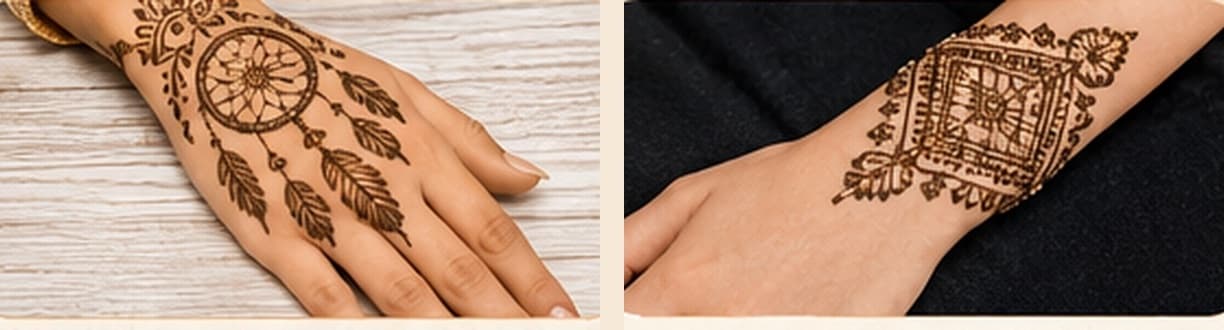
Tattoo mehndi borrows the visual language of permanent tattoos but uses temporary henna. Popular motifs include dreamcatchers, feathers, mandalas, arrows, geometric shapes, symbols, names, and short words.
Unlike full-hand bridal designs, it usually focuses on one spot — the wrist, forearm, shoulder, ankle, back, or fingers. It's a practical choice if you love bold body art but don't want a permanent tattoo: the stain fades naturally as the outer layer of skin renews.
Best for — parties, vacations, music festivals, fashion events, and casual temporary body art.
How to choose the right style
- Weddings and traditional ceremonies — Indian or Rajasthani mehndi gives the most elaborate, symbolic look.
- Bold but quicker — Arabic mehndi delivers elegance with less density and a faster application.
- Small functions and modern outfits — minimalist mehndi keeps it subtle.
- Creative occasions and destination events — Indo-Western and tattoo mehndi work especially well.
- Receptions, parties, and photoshoots — white and glitter designs shine when the immediate look matters more than a lasting stain.
Tips for a darker natural stain
- Keep natural henna paste on the skin for several hours and let it dry fully.
- Scrape the dried paste off gently — don't wash it away immediately.
- Avoid contact with water for several hours after removing the paste.
- Be patient: natural henna develops from orange to a deeper reddish-brown over the next 24–48 hours.
Avoid "black henna"
- Skip so-called black henna unless the ingredients are clearly verified. Products containing PPD (para-phenylenediamine) can cause serious skin reactions.
More than decoration
- Mehndi represents celebration, beauty, creativity, and cultural identity. The best design is simply the one that complements your celebration and makes you feel confident.
Find the right mehndi artist on Meilo
Every artist has a different style, experience level, price, and availability — and the difference between an average and a beautiful design comes down to the hands holding the cone. Meilo lets you browse mehndi artists' actual work before you book, so you can see whether they specialise in bridal, Arabic, minimalist, Rajasthani, or contemporary designs.
- Compare portfolios and real design quality, not just claims
- Check experience with bridal or event mehndi
- Read customer ratings and reviews
- See pricing, packages, and travel availability
- Confirm availability for your date and estimated application time
- Share reference pictures and agree the design, coverage, and schedule up front
Before you book
- Which mehndi style is best for a bride?
- Traditional Indian and Rajasthani mehndi are the classic bridal choices — dense, symbolic, full-coverage designs, often with hidden initials or bride-and-groom portraits. Expect several hours of application for the most elaborate work.
- What is the difference between Indian and Arabic mehndi?
- Indian mehndi covers most of the hand with dense, intricate patterns. Arabic mehndi uses bold floral trails and deliberately leaves open skin as part of the design, so it looks striking but applies much faster.
- How long does mehndi last?
- A natural henna stain typically lasts one to three weeks, fading gradually as the outer layer of skin renews. White and glitter mehndi is cosmetic and surface-level — it lasts only until it's washed or worn off.
- How do I get a darker mehndi stain?
- Leave the paste on for several hours, scrape it off instead of washing, and avoid water for a few hours afterwards. The colour deepens from orange to reddish-brown over the next 24–48 hours.
- Is black henna safe?
- Be cautious. Many "black henna" products contain PPD (para-phenylenediamine), which can cause serious skin reactions. Stick to natural henna, and always patch-test cosmetic white or glitter products first.
- Is white mehndi real henna?
- No — white mehndi is made with skin-safe cosmetic adhesive or body paint. It sits on top of the skin rather than staining it, which is why it photographs brightly but washes off rather than fading.
- Which mehndi style is fastest to apply?
- Minimalist designs are quickest, followed by Arabic patterns, since both use open space and fewer fine details. Dense bridal styles like traditional Indian or Rajasthani can take several hours.